← ALL RECIPES / COPYCAT

Barnaby's-Style Tavern Pizza

Prep 30 min + overnight cure · Bake 10–15 min · Makes two 12-inch pizzas · Life stories: 0 · Cut: squares
Nothing about this recipe reminds us of our grandmother. Moving on.

The Dough (Two Thin Crusts)

Ingredients

  • 300g bread flour (about 2.5 cups)
  • 6g sugar (about 1½ tsp)
  • 6g salt (about 1¼ tsp table salt or 1¾ tsp kosher)
  • 2g instant yeast (about ¼ tsp)
  • 150g cold water (about ⅔ cup)
  • 30g neutral oil (corn oil is the way to go here — it's the move for all Chicago-style pizzas)
  • Cornmeal, for dusting underneath the crust

Steps

  1. Mix the flour, salt, sugar, and yeast together in a stand mixer (see the sifting tip). Add the water and corn oil and mix on low with the dough hook, scraping down with a spatula periodically so everything incorporates. Turn the mixer off for about 10 minutes, then mix on medium-low about 5 minutes, until the dough starts pulling away from the sides.
  2. Turn it out onto a big cutting board dusted with a little flour.
  3. Cut into two even pieces and roll into smooth balls.
  4. Put each ball in a separate container big enough for it to grow 2–3× in size, and roll them in a little more corn oil.
  5. Let the dough ferment — pick your patience level: room temp until doubled (~3 hrs) is fine; overnight in the fridge is better; 3–5 days in the fridge is best if you have time. Since you have two balls, do one quick and leave the second in the fridge longer to taste how the dough flavor compares.
  6. The morning of (or the night before) bake day, roll a ball out on a well-floured surface into a very thin 14-inch circle — the crust-making step shrinks it to about 12 inches in the end. If the dough springs back as you press it, let it rest covered 30 minutes before trying again.
  7. Cure the dough: put the rolled-out 14-inch crusts on parchment or butcher paper and leave them uncovered at room temperature (the whole day, or overnight, depending on when you remember you want pizza later) until the tops are dry and a little leathery. Knock down any bubbles with a fork.

✏️ Corn oil is the way to go here — it's the move for all Chicago-style pizzas.

Component: The Fennel Sausage

Ingredients

  • 1–4 tbsp whole fennel seeds (fennel is the most important part of a Chicago tavern-style pizza — it's possible to overdo it, but making it yourself lets you put in more than any mass-produced sausage company ever will)
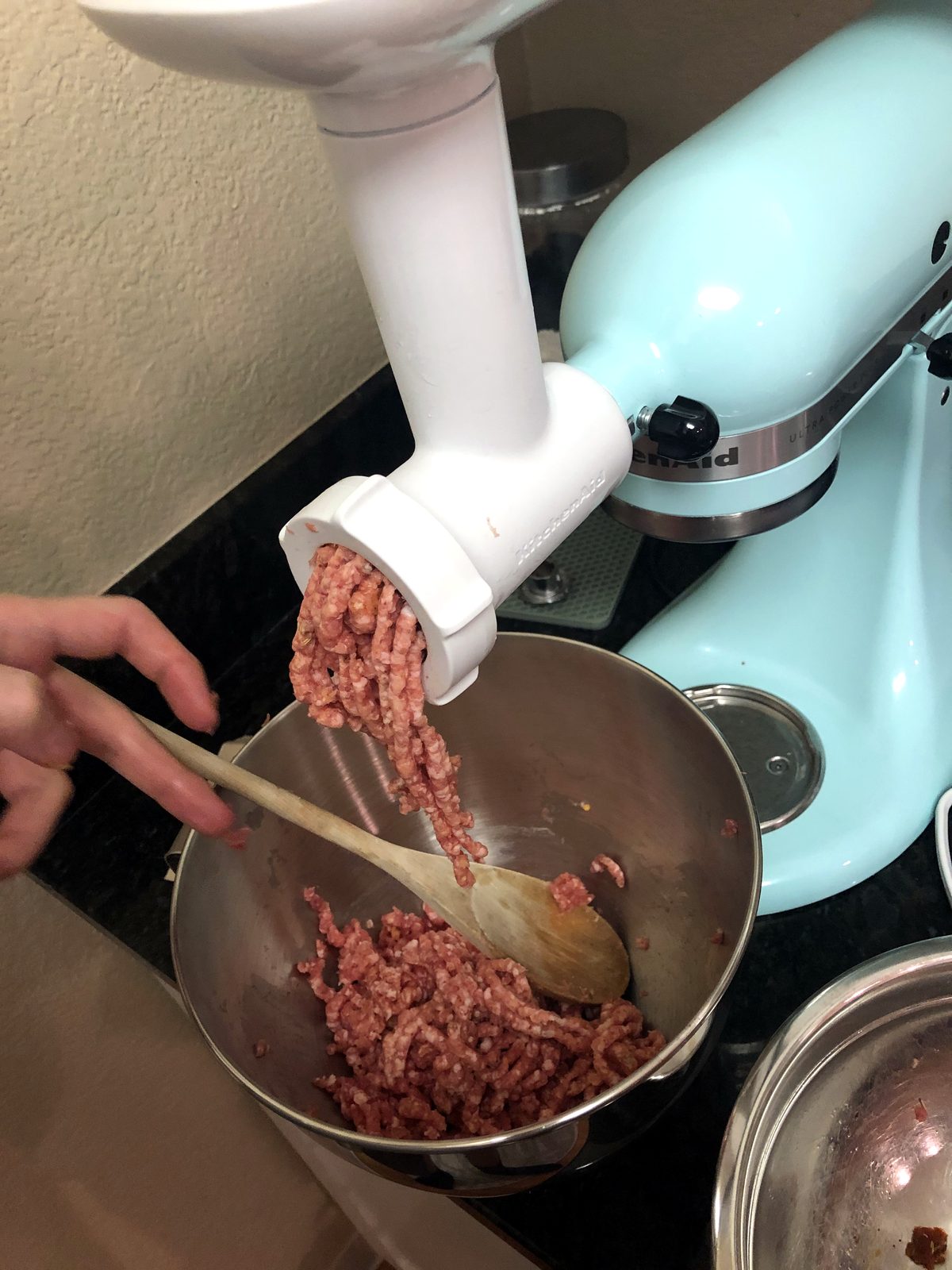
  • 1 lb ground pork (or, if you're brave, grind your own with the meat-grinder attachment for the stand mixer — honestly probably not worth the effort, but when you own the thing you have to use it sometimes)
  • 4–8 garlic cloves, minced (garlic is good)
  • 7g salt
  • 2 tsp garlic powder
  • 2 tsp dried oregano
  • 1 tsp dried marjoram (or just don't, if you don't want to buy marjoram and keep it in the house for the next 10 years waiting to use it again)
  • ½ tsp ground black pepper
  • Large pinch red-pepper flakes

Steps

  1. Quickly toast the fennel seeds in a dry skillet over medium heat (no butter or oil), stirring, for just a few minutes. If you have a spice grinder, smash them up a little — but not to a full powder.
  2. Combine all the ingredients in a bowl and mix (a food-prep glove helps) until fully incorporated.
  3. Shape into small round blobs, 1–2 tsp each.
  4. Bake on a pan at 450°F (same temp as the pizza) about 3 minutes — just long enough to crisp them a little and render out some grease so it doesn't soak into the pizza.

Component: The Sauce (same as the Rocky Rococo)

Ingredients

  • 15 oz (425g) can tomato sauce
  • ¼ teaspoon fennel seeds
  • ¼ teaspoon red pepper flakes
  • 1½ tablespoons (19g) granulated sugar
  • 1 teaspoon dried oregano, crushed
  • 1 tablespoon dried basil, crushed
  • 1½ teaspoons finely minced garlic
  • 1 teaspoon sea salt
  • ½ teaspoon ground black pepper

Steps

  1. Stir everything into the tomato sauce. That's the whole step. Make it ahead if you can — it gets better as it sits.

Assembly & Bake

Ingredients

  • The cured dough (above)
  • The sauce (above)
  • The par-baked fennel sausage (above)
  • Mozzarella cheese (see the Galbani tip)
  • Cornmeal, for the stone
  • Fresh grated parmesan and/or red-pepper flakes, to serve
  • A pitcher of root beer and comically small plastic cups (non-negotiable — see tips)

Steps

  1. Put a pizza stone in a 450°F oven for 15–30 minutes to heat through — this is what crisps the bottom of the crust.
  2. While the stone heats, flip a cured dough upside down onto parchment, a cutting board, or a pizza peel, so the dry side is now on the bottom and it'll slide off easily later.
  3. Poke a lot of tiny holes across the top of the dough with a fork to help it bake through crisp.
  4. Add a generous amount of sauce, mozzarella, and the par-baked sausage pieces over the top.
  5. Make the ribbed crust the way Barnaby's does — a pinch-and-pull motion all the way around the rim. This is probably the hardest step of the whole bake.
  6. Take the hot stone out of the oven, set it on a trivet, and spread cornmeal generously across the top (careful — it's very hot).
  7. Gently slide the pizza onto the stone, leaving at least a half inch of space around the edge.
  8. Bake about 10–15 minutes, until the edges are dark and almost charred and the cheese on top is starting to brown.
  9. Pull it out, slide it onto a cutting board, and cut the round pizza into squares (important — you'll only get 4 to 9 real squares out of it, but that's how it works).
  10. Serve with fresh grated parmesan and/or red-pepper flakes.
  11. Serve with a pitcher of root beer and very small plastic cups, so you have to pour at least 20 times to finish the pitcher.

TIPS — from a person who has actually made this

  • Sift the flour through a colander before mixing to break up any lumps — an even flour makes for a more consistent thin crust. A real sifter works too, but the colander's already clean.
  • For the cheese, Galbani Italian-style mozzarella — the roundish block sometimes labeled “classic melt & stretch,” found near the cheese slices — melts better than shredded and looks less plasticky than the rectangular low-moisture bricks. Target's store brand is a solid stand-in.
  • The pitcher of root beer is not optional, and neither are the comically small cups. They force roughly twenty pours to finish a pitcher, which is the correct amount of ceremony. Serving tavern pizza with root beer in a normal, sensibly-sized glass is considered — at Barnaby's and here — a character flaw.
Barnaby's-Style Tavern Pizza
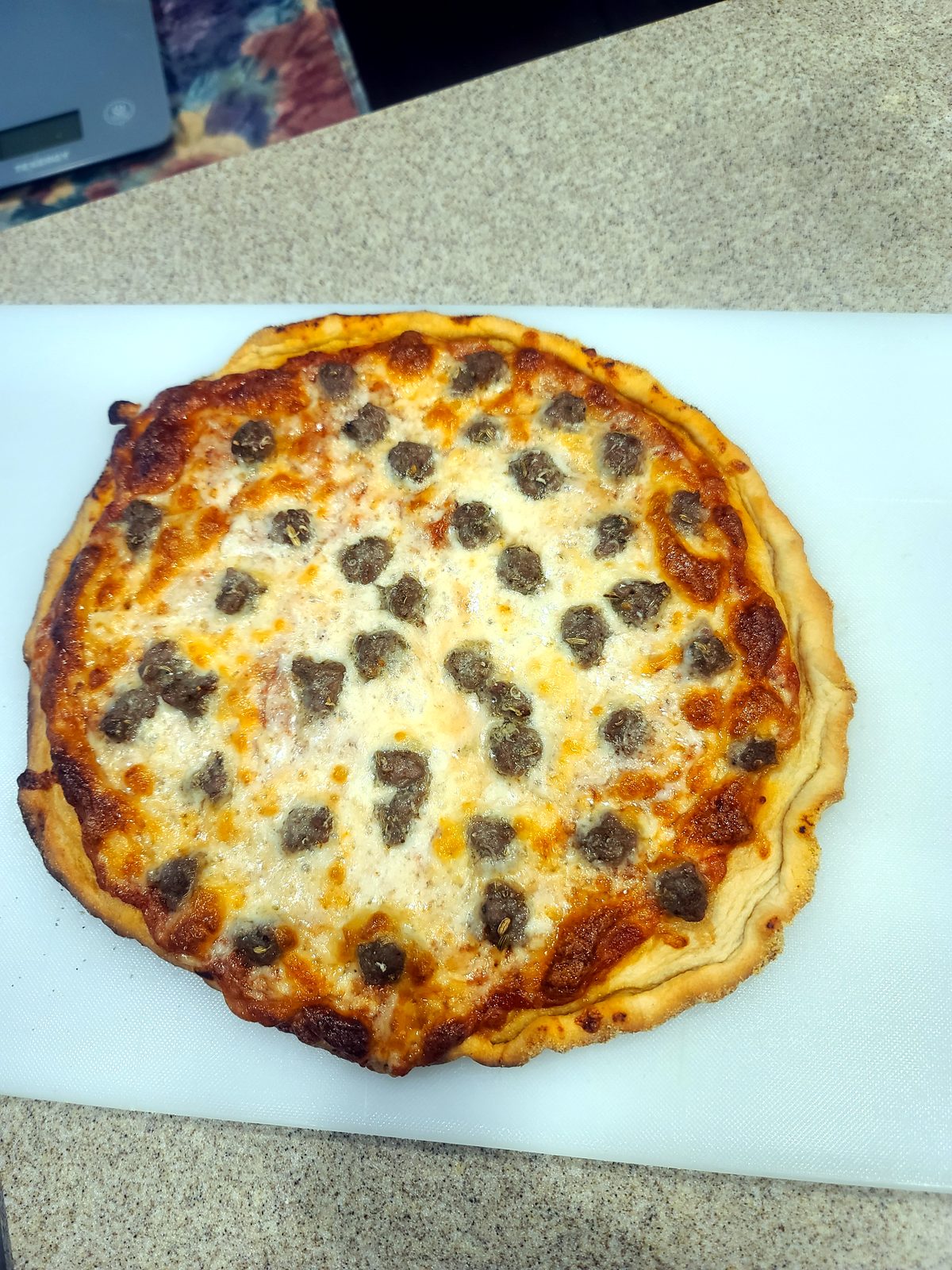
The finished pie — round out of the oven, about to be cut into squares. Sausage placed for per-square coverage, edges pushed nearly charred the way tavern crust should be.
Barnaby's-Style Tavern Pizza
Grinding the pork with the stand-mixer attachment. Not necessary. But you own the thing, so every so often it has to earn its shelf space.
⚠ AI-Generated Nostalgia — 0% True

The Family Story Nobody Asked For

Every food blog has one. Ours is at the bottom, where it belongs, and was written by a robot with no family. Reading it is strictly optional and mildly discouraged.

Barnaby's sits in Niles, Illinois, dim and wood-dark, with stained-glass windows that turn an ordinary afternoon into something that feels vaguely like church — if church served cracker-thin pizza cut into squares. My grandmother — Grandma, no further identification required or permitted — held it as settled law that this was the only acceptable place to bring anyone who flew in from out of town. Not the first stop. The only stop. You could land at the airport and, before your suitcase had finished its lap on the carousel, Grandma had already decided you were going to Barnaby's, whether you had opinions on the matter or not.

This was not a preference. It was a screening process. Cousins, in-laws, a college roommate passing through, a man from the electric company who made the mistake of mentioning he'd 'never really had Chicago pizza' — all of them were routed to Barnaby's with the efficiency of an air-traffic controller who had personally decided where every plane would land. 'You'll see,' she would say, which was the entire briefing anyone received. She was always right, which meant that in her hands the phrase 'you'll see' worked as both invitation and verdict.

On toppings, Grandma recognized exactly one, and it was sausage. It had always been sausage. A cousin once ordered a pizza with green peppers on it in her presence, and the temperature of the whole booth changed. She didn't say anything — Grandma rarely needed to say anything — but she regarded the peppers the way a customs officer regards an undeclared item, and the cousin, to his credit, understood at once that he had done something, and quietly never did it again. Mushrooms were a fantasy. Pineapple was not a word that was spoken aloud. There was sausage, generously fenneled, and there was error.

The root beer was a toll, and she was explicit about it. You did not simply sit down in Barnaby's dark, stained-glass hush and receive pizza — you paid, up front, by ordering a pitcher of root beer and accepting the little cups. To Grandma the pitcher was the price of admission to the room itself, the wood and the glass and the low churchy light, and anyone who tried to order pizza without it was, in her assessment, attempting to sneak in. 'You want to sit in here,' she'd say, gesturing at the stained glass like a docent, 'you buy the pitcher.' Several people tried to argue the point. The stained glass outlasted all of them.

The cups, naturally, were the size of a communion sip, which meant a single pitcher took something north of twenty individual pours, and Grandma treated each one as a small ceremony she had no intention of rushing. She poured for the table herself. This was not open for discussion. You got your thimble of root beer when Grandma decided you got it, and you thanked her, and if you drank it too fast she noted this — silently, the way she noted everything — and filed it away in whatever vast internal ledger she kept on all of us.

The room did the rest. Barnaby's is dark in a way modern restaurants have forgotten how to be — dark on purpose, dark as a design philosophy — and the stained glass throws colored light across the tables until a Tuesday dinner takes on the weight of an occasion. Grandma loved this. She held that a person ought to have to leave the daylight behind to eat properly, and Barnaby's obliged her completely. Out-of-towners would come in squinting from the parking lot and walk out two hours later blinking, converted, square pizza still on their breath, having been shown.

Recreating it at home is, in the end, a way of trying to earn her approval from a distance — the sausage doing the heavy lifting, the crust ribbed and cut into its four-to-nine squares, and yes, a pitcher of root beer, because I can still hear the ruling on that one. It's never quite the room in Niles with the colored light and the settled law of the place. But it's close, and it's sausage, and there is not a green pepper within a mile of it. Grandma: the pitcher's paid. The recipe is above, where you'd expect it, cut into the correct shape.

The End. The recipe was above, where you already found it.
Inspired by The New York Times Cooking.